Yummy Fig, Fennel, and Goat Cheese Bars Fig, Fennel, and Goat Cheese Bars
Just this week, my fig tree delivered its first ripe fruit of the season. Every year it produces more and more figs, and besides giving them away to friends and neighbors, I’m finding new ways to use this special, luscious fruit. Figs in all stages. So pretty!
Last year I made fig and ginger compote—so yummy on toast—and this year, I continue to throw them on the grill alongside my garden veggies. If you haven’t tried this, please do. The figs caramelize into a gooey softness and they are wonderful in a goat cheese salad, onto crostini, as an accompaniment to grilled pork or chicken, and on top of ice cream. The possibilities are endless so use your imagination. Almost anywhere you would use grilled fruit, such as peaches, you can substitute figs.
In my upcoming book, The Sicilian Sorceress, my main character, Alexis, makes fig bars for her clients so I thought I’d get into her head and create my own version. The result was amazing! I used ingredients popular in ancient Sicily: figs, almonds, goat cheese, Greek yogurt, and fennel. The recipe for Fig, Fennel, and Goat Cheese Bars is in the book so unfortunately, I can’t reveal it just yet. Sorry! It will soon be available within the next two months. Please subscribe to my monthly newsletter at Mary Knight for interesting articles and updates on a publication date. The Sicilian Sorceress has several Sicilian recipes, many I learned while in Sicily. Follow me along as I continue to be inspired by Mediterranean cuisine!
Ciao for now,
Love is a fruit in season at all times, and within reach of every hand. –Mother Teresa
Have you ever been to a place that brought forth such a surge of emotion that it vibrated into the deepest part of your soul? A place so powerful, so ancient, that its energies pulsate, like a heartbeat, and still feels alive, even now, over 2500 years later? This is how I felt while visiting Agrigento or The Valley Of Temples on the south coast of Sicily. The extraordinary UNESCO site is preserved in honor of the Greeks, who built these magnificent temples to honor their gods. So humbled by this experience, I felt as if I were bowing to a lion.
Check out the view of the ocean from the temples.
The Greeks built their society on these dusty hills overlooking a turquoise sea to demonstrate their strength when viewed from below. It must have been, and still is, imposing and overwhelming in its grandeur. Almost as if giants lived here. Monumental Doric columns made of sandstone frame the temples, their walls lost to history and war, leaving a hollow, a void to be filled only by the spirits of their worshippers. But the small bodied Greeks, working their hearts out to create gratuity for their gods and goddesses, somehow designed and built temples that would last, freezing their time in existence. Hard to imagine!
A Telemone which is a male figure used as a pillar. His head is to the left and his arms are raised as if he is lifting something.I’ve not been able to identify this statue, although I saw a replica of it in Pietrasanta a few years ago.
At every temple site, with headphones glued to my ears, I listened to the stories behind each structure; The Temples of Juno, Zeus, Hercules, Dioscuri, Persephone and Demeter. I was getting a Greek mythology lesson and I loved it. A thriving city-state housing over 300,000 inhabitants, Agrigento prospered under Greek rule and was respected for its brilliant architecture and its beauty. These people had it all. A fishing port down the hill. A valley behind, named Kolymbethra, abounding with orchards, gardens and wildlife. It came complete with a sophisticated hydraulic irrigation system, to be the envy of any present-day gardener. What more could you ask for? I guess that is why it was so heavily fortified, only to be conquered and re-conquered for its abundance of natural resources as well as its strategic positioning.
They say the average stay at Agrigento is two and a half hours and we were there for more than five. I could have stayed longer. Kolymbethra’s garden oasis enchanted and seduced the gardener in me.
If I had lived here, my job would have been to be a caretaker of this splendid paradise. Cool breezes filtered through the orange, lemon, apple, pear, bergamot, mulberry, fig and pomegranate trees that lined a pathway on both sides of the canyon. I walked further along, surrounded by olive and almond trees, artichoke stalks, and vegetable gardens, all strategically irrigated via narrow ditches guiding water from a nearby pool. Every food I love, right here. A gastronome’s paradise. I wondered, who were the cooks, the chefs and how did they prepare this plenitude, these riches and gifts of the earth? My research revealed a lack of details on food preparation but I did find this great site about the kinds of food grown by the Greeks. The website is called Spruce Eats. If I were the cook, I’d prepare sardines and prawns with freshly pressed olive oil, fennel, cucumbers and olives served over thyme infused barley. For something sweet, I’d bake little cakes with the almonds and pistachios and maybe add a little saffron. How about figs soaked in pomegranate juice or artichokes steamed with citrus peel? The options were endless! And delicious!
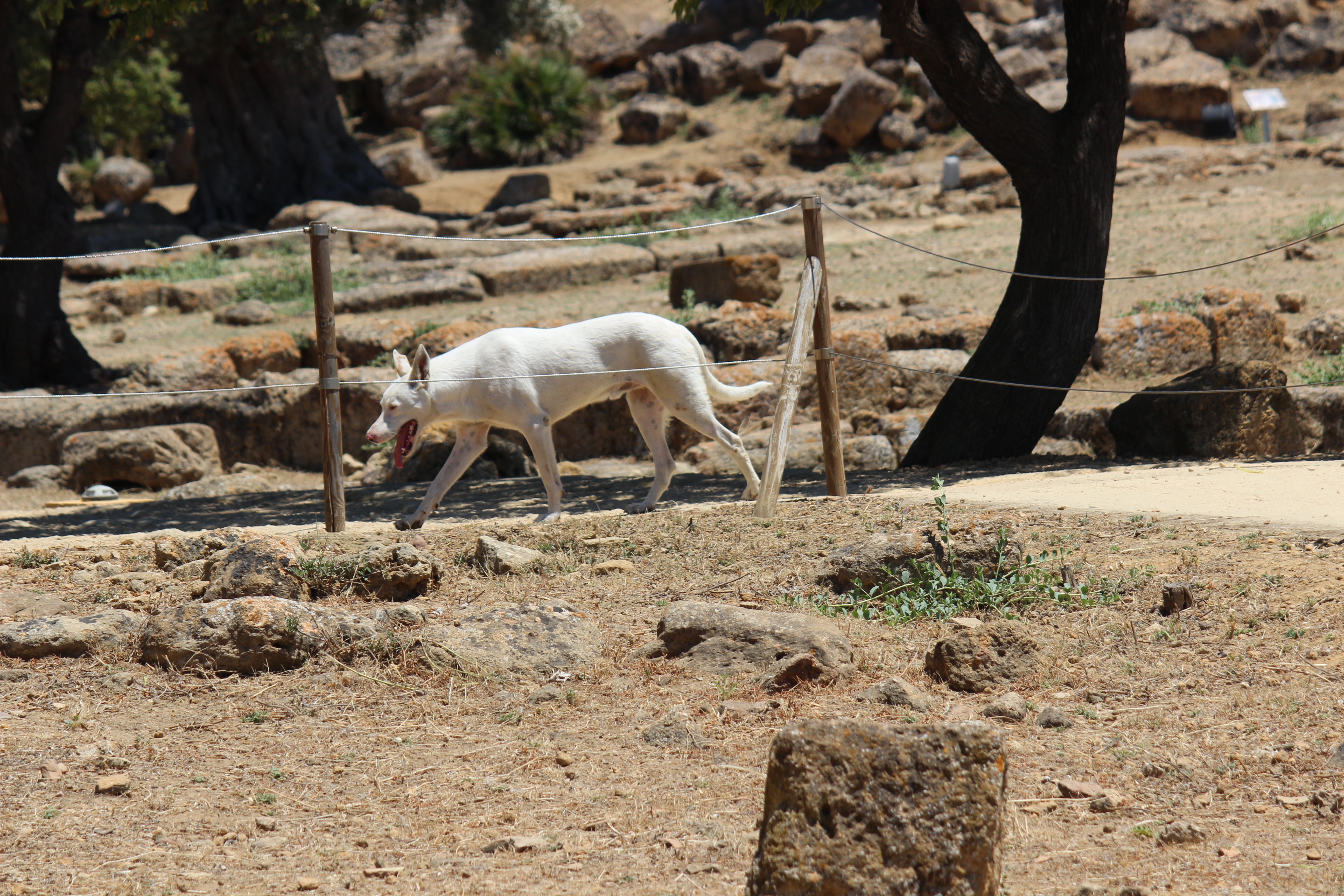
I spotted this mysterious dog running from hiding place to hiding place, obviously hot. He looked like a ghost of a Greek spirit.One side of the irrigation system in Kolymbethra.The water travels across and into the vegetable gardens.Kolymbethra. A tree bearing mini pears. They are so delicious!
“Agrigento!” is the first word out of my mouth when someone asks me about the highlight of my trip to Sicily. Since I’ve not yet been to Greece, these ruins gave me a deeper perspective on life and a respect and reverence for the ancient Greeks. How did we get so far away from simplicity? Ok, I know their life wasn’t simple – I’m sure it was hard but what mattered to them were their gods and goddesses, survival from invaders and attention to nature and its natural resources. How can we, as a society, bridge the gap?
Temple of Dioscuri. We became friends. Very strong earth energy.
Empedocles (c. 492-432 BCE), who came from Agrigento, famously said of the city’s inhabitants and their easy living: ‘…they party as if they will die tomorrow, and build as if they will live for ever’. (Found on the Ancient History Encyclopedia, a fantastic website!)
Il Fiorentino. Pistachio heaven with Pino and Franca.
A Pistachio Inspired Pranzo
A review of Il Fiorentino, Bronte, Sicily
Another lovely blue-skied day in Sicily. Today’s adventure and culinary find takes us from the aquamarine sea to a mountain top and then half-way down the other side. All this to reach our lunch (pranzo) destination, Il Fiorentino, in the paise (village) of Bronte. Bronte is well-known for its pistachios grown in the foothills of Mt. Etna. Sicilians take pride in this regional nut, claiming the minerals from the lava in the earth give the pistachios a special richness and intensity to their flavor.
It is a Monday and most eateries are closed on Mondays. Roberto called ahead to double-check and the owner replied, “Si!, viene!” Winding curvy roads, with views that resembled the Rocky Mountains, the terrain suddenly dips down into vast open meadows filled with colorful cows and even llamas. Around another corner and Roberto immediately swings into a street parking spot right in front of the restaurant. Arriviamo! We walk through the beaded curtain entrance and are greeted by Pino, the owner. A warm, fuzzy feeling takes over, like I am entering a friend’s home, someone who has lived here for a very long time. The room’s light comes only through its windows. Old memorabilia line the walls and shelves while crisp, white tablecloths anchor the maybe 10 tables. Charming. As it happened, Il Fiorentino is closed but Pino opens just for us! We will have a private pranzo, cooked to order.
Interior of Il Fiorentino, Pistachios are their specialty!Pino is a small man, maybe mid 60’s, conservatively dressed in a shirt and buttoned up v-neck sweater, wearing a closed-lipped grin. He hands us menus but Roberto clearly knows the ropes and orders for both of us. A bottle of water and a carafe of red wine are placed on the table and the feast begins.
Trio of Bruschetta
A trio of caramelized onion, pomodoro and herb bruschetta sets the tone for the meal. Roberto orders a primi of antipasto to share. An abundance and variety of textures and colors activates my taste buds. Caponata, green beans, home-cured salami, local olives and caciocavallo cheese, fried potatoes and two kinds of stuffed and fried squash blossoms fill every corner of the plate. I first dig into the fried, mozzarella-stuffed squash blossom, its cheese oozing all over my fork. The salty, melting warmth brings forth a squeal of delight. Pino’s grin widens as he watches me eat with such pleasure. I enjoy the local caciocavallo cheese so much, he returns with another large slice and sets it next to me. So sweet.
Exquisite Antipasto Plate
Il Fiorentino’s menu offers two kinds of their specialty pasta with pistachios, “Casarecci al Pistacchio.” It is a warm day and Pino suggests the “red” pasta with tomato, eggplant and onion for me. Roberto likes the “white” pasta in a light cream sauce. The presentation in beautiful Sicilian ceramic bowls make this experience extra special. Both dishes are heavily dusted with freshly chopped pistachios. Pino makes sure I understand that he has picked and shelled these pistachios. I eat slowly, savoring every bite. When I reach the bottom of my bowl to scrape every last morsel onto my fork, I am greeted by a smiling sun face! It was if she is saying, “I’m glad you enjoyed me so much!”
Pistachio Smothered PastaMiss Sun made my day!
Our plates are cleared away and Pino asks, “Would you like some cherries?” Certo! A bowl of just picked and perfectly ripe burgundy beauties is placed between us and we eagerly bite into the juicy flesh. Pino is obviously still enjoying our display of delight with his food.
Palate cleanser of cherries
Il Fiorentino’s specialty dessert is pistachio gelato served with pistachio cake. Even though I am feeling pasta-full, I cannot resist dessert. I take a scoop of the intensely flavored, nutty gelato and smear it on top of the cake to eat them together. Ice cream and cake! I especially love the moist cake with a slightly sugar crunch on top. My pastry mind is putting the ingredients together. Meringue? Flourless? So enamored with the cake, I ask Pino how it is made. He shrugs his shoulders and then leads me to the kitchen to meet his wife, Franca, who is the star chef of the restaurant. Delighted by the compliment, she eagerly shares her recipe with me. I am overwhelmed by her kindness.
Pistachio cake plus pistachio gelato. A match made in heaven!
For me, this is the definition of a great dining experience. Besides fantastic fresh food, it’s the warm hospitality in a comfortable home-like setting. Mostly, it’s Pino and Franca who so lovingly share their livelihood, that forever will endear me to Il Fiorentino. If you are ever in Sicily, do not miss the opportunity to dine with them!
Here is Franca’s recipe for the Pistachio Cake.
Franca's Sicilian Pistachio Cake
A light and flourless cake studded with pistachios
I’ve tasted some pretty incredible things on my world-wide travels but did not expect for Sicily to offer foods that almost made me speechless. Seriously! Fine pastries in France, fresh seafood in Australia and robust goulash in Budapest all stand out as epic food experiences. What great Sicilian taste made my heart beat a little faster? Granita. If you have ever tasted Sicilian Granita, you understand. If not, it’s worth the trip just to find out – and fall in love.
The warm morning after I arrived in Catania, my host and guide Roberto announced, “You must have a granita for breakfast.” Many “bars” (our version of a coffee shop), offer coffee, pastries and granita for the morning’s greeting. My first introduction to granita made me a true believer in the seduction of Sicilian food. If this was the first of many local foods that made my body quiver with lust for more, how many more Sicilian specialities were on this gorgeous island?
It’s not easy to describe granita but I’ll try. Creamy (although there is usually no dairy), fluffy, cold, melt-in-your-mouth, and flavor intense, not sugary sweet. It is not formed with a scoop, like a sorbet, but served a little slushy. It’s made with fine flakes of ice frozen together with sugar and fruit. Other flavors may include almond, pistachio, coffee, or chocolate. Most bars serve almond, a favorite, coffee, lemon, pistachio and strawberry. This is a Sicilian ritual for breakfast when the weather heats up, accompanied by a warm brioche or other delectable pastry.
At the Bar del Santuario, my favorite stop for granita, you saddle up to the counter and order your choice of granita and pastry. Then choose an outdoor table overlooking a lovely park, alive with people and a flowing fountain. A handsome, well-groomed server brings your granita in a stemmed glass dish with a tiny spoon, a plate with your pastry and a glass of water. The only distracting thing on the table – an ashtray. You pay at the cashier inside only upon finishing your breakfast. Two granite and two pastries cost about 5 Euro or $5.75. Yes, the delicious food is much cheaper than the rest of Italy. Affordable for all, locals and tourists alike.
Mandorle granita and brioche
Mandorle (almond) with a shot of espresso on top became my fast favorite. Silky almond and sharp contrast of espresso was the perfect marriage, destined to last a lifetime. “Roberto! I want to eat this everyday for the rest of my life!” My emotional side was taking over. The mandorle is made with freshly extracted almond milk, almonds being a key ingredient in many Sicilian foods and also a major player in the agriculture scene. Each day I tried a new pastry to go with it. Buonissimo! (So good!). So addicting is granita that my day just wasn’t right without this starter.
Gelsi granita
During my two weeks in Sicily, I tried many flavors of granita. Gelsi, or mulberry is a seasonal specialty, and its dark eggplant color mirrored its deep berry flavor. At Caffe Sicilia in Noto, I tried strawberry tomato granita, with a color of rhubarb. Sounds strange but somehow the tomato just barely tames the flavor of the strawberry, pushing forth really ripe tomato for balance that is indescribable. When I asked the person next to me in line which item was his favorite, he quickly replied. “Strawberry tomato granita!” So I was not alone.
Strawberry tomato granita
I was surprised to learn that Sicilians rarely use ice. No ice in water. And to cool iced tea – what else? A scoop of lemon granita. Exquisite!
Tea with lemon granita
My last day in Sicily, I tried half strawberry (with fresh local berries) and half pistachio. Equally yummy. All fruit flavors are made strictly with fresh fruit of the season. I know you can make it here but it will never match the homemade quality and intensity of flavor only found in Sicily.
Strawberry pistachio granita
Yes, I would return to Sicily for the mere pleasure of savoring granita from coast to coast. Sicily – this one’s yours to keep!